

MSICS Simulation -Virtual Reality Training (AI-LAB)
Introduction
Nepal’s eye care system is well known worldwide for its strong community programs and affordable, high-quality cataract surgeries. However, the country faces a shortage of specialists and unequal distribution of services, with only about 400–500 ophthalmologists. The demand for cataract surgery is increasing faster than the available surgeons. In addition, as ophthalmology has expanded into different subspecialties, many doctors are choosing specialized fields, which means fewer surgeons are mainly focused on cataract surgery.
Newly trained ophthalmologists also often have limited opportunities to perform sufficient supervised cataract surgeries during their early careers, making it challenging to develop confidence and surgical competency traditional training models. Limited supervised operating time, patient safety concerns, and resource constraints slow down learning and increase stress. To address this, the MSICS Simulation – Virtual Reality Training (AI-LAB) Course offers a structured, simulation-based program that bridges the gap effectively. This course equips novice surgeons with essential MSICS skills in a safe, risk-free environment. By combining online learning, high-fidelity VR simulation, and wet-lab practice, it helps reduce surgical errors, shortens the learning curve, and improves patient safety enabling trainees to confidently address Nepal’s growing cataract burden with better outcomes.
Key Objectives of the Course:
- To provide novice surgeons with a safe, risk-free environment to master essential MSICS surgical steps, instruments, and techniques through virtual reality simulation and wet-lab practice.
- To accelerate the learning curve, reduce surgical errors, and enhance patient safety by building strong foundational skills before live surgery.
- To promote repetition, deliberate practice, and objective assessment, enabling trainees to achieve competence in MSICS.
- To reduce anxiety among trainees, improve instructor-trainee communication, and prepare surgeons to effectively address cataract backlog with high-quality outcomes.
This program equips aspiring ophthalmologists with transferable microsurgical skills that support both MSICS and broader cataract surgery practices, ultimately contributing to better eye care access and reduced blindness.
Highlights of the Course:
- MSICS Training Pathway: Combines Cybersight online courses, VR simulation, and wet-lab practice
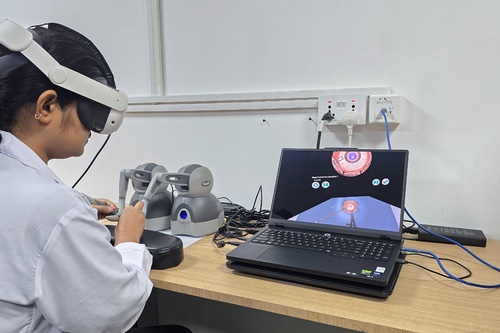
- Access to State-of-the-Art MSICS VR Simulator: Practice all 24 surgical steps in a realistic, risk-free environment with haptic feedback and objective assessment.
- MSICS Essential Online Courses: Complete the official 2-hour “Step-by-Step” course plus access to Cybersight’s extensive video library and resources.
- Intensive Wet-Lab Practice: Perform 15–20 MSICS procedures on goat eyes, covering key steps including sclero-corneal tunnel creation, capsulotomy, nucleus delivery, IOL implantation, and wound closure.
- Suturing Skills Training: Hands-on practice using different ophthalmic sutures and needles, along with understanding principles of suture placement and needle passage.
Eligibility Criteria:
Candidates enrolled in Postgraduate Ophthalmology Program after completion of 6 months of course
Qualified with MD/ MS/DO/ DNB degree from recognized university.
Duration: 1 week
Course fees:
For Nepali & Indian candidates: NPR 25,000
For International Candidates: $ 200
Mode of payment: Candidates are required to make payment online upon receipt of the official invoice and admission confirmation letter
Accommodation: National candidates are responsible for arranging their own accommodation. For international candidates, accommodation will be arranged within the hospital campus or at a nearby hotel, subject to availability. Meals will be provided at the hospital canteen and charged on an actual consumption basis
Application Process:
Applicants are requested to apply through Biratnagar Eye Hospital www.leecs.org with the ophthalmology degree. Selected candidates will receive information from Biratnagar Eye Hospital within two weeks of submission of the application. Upon Successful payment of the course fee, admission letter will be sent.
For International Candidates:
International applicants must obtain a Temporary Registration Certificate from the Nepal Medical Council (NMC). The registration process is coordinated through the organization and may take time. Placement and scheduling will be confirmed only after NMC registration approval
For more Information/enquiries, contact
Course Coordinator
Biratnagar Eye Hospital, Biratnagar
Phone No: +977-9768684560
Email: dth.coordinator@erec-p.org